Small yellowish flakes on a baby's scalp, or a dusting along the eyebrows, send plenty of parents straight to a worried search. Sorting cradle cap vs dry skin comes down to three cues: how the flakes look, how they feel, and how firmly they hold on.
Both are common, both are manageable, and neither is a verdict on a family's hygiene. The American Academy of Pediatrics is explicit that cradle cap is not caused by poor hygiene, an allergy or an infection.
A One-Minute Scan to Tell the Flakes Apart
The fastest way to sort what a parent is seeing is to look at three things in quick succession.
- Colour and thickness. Cradle cap tends toward yellowish, slightly waxy patches that build up in one spot and can form a crust. Plain dry skin runs paler and thinner, more like fine dust than a crust.
- Texture. A clean fingertip drawn lightly across the area tells most of the story. Cradle cap is described by the NHS as greasy and scaly; dry-skin flakes feel powdery and loose.
- Grip. Cradle cap holds to the scalp and forms a crust that flakes off over time. Dry flakes lift and shed with a soft touch or a normal wash.
| If it looks like this | Think this | What it needs |
|---|---|---|
| Yellowish, waxy, crusted, sticks to the scalp | More like cradle cap | Gentle softening and patient washing |
| Pale, powdery, sheds easily, skin feels tight | More like dry skin | Moisture support, gentler cleansing |
There is no need to clear every flake in one bath. The AAP's advice is that cradle cap does not need treating at all; washing more often simply helps the scales come away more easily.
What Cradle Cap Actually Is
Cradle cap is a form of seborrheic dermatitis found on the head, and it is extremely common: the AAP puts it at 70% of three-month-olds. Instead of fine, powdery shedding, a parent tends to find thicker scales gathered into patches, often across the crown or along the brow line, running yellowish and slightly greasy.
Here is the part that surprises many parents: the baby usually could not care less. Both the AAP and the NHS describe cradle cap as rarely itchy or uncomfortable, and most babies carry on feeding, sleeping and grinning through it. More often it is the parent who feels unsettled by the look of it.
Nobody knows exactly what causes it. The AAP sets out two working theories: a reaction to a common yeast that everyone carries on their skin, or the mother's hormones prompting a baby's oil glands to overproduce. Neither points to anything a parent did or failed to do.
Where the Flakes Show Up, and What That Does Not Tell You
Location is the cue parents lean on hardest, and it is the one most often got wrong. It is widely repeated that cradle cap stays on the scalp. It does not.
The AAP is clear that the same scaly rash may also show up on a baby's face, armpits, neck crease and diaper area, and that when it appears somewhere other than the scalp it is simply called seborrheic dermatitis rather than cradle cap. The NHS describes the same pattern, listing the scalp and face and noting it sometimes affects the nappy area and the skin creases.
So a flake behind an ear or in a neck fold does not rule cradle cap out, and it is not a sign that something is spreading out of control. What location genuinely tells you is narrower:
- Flakes on the scalp and hairline fit either picture, since dryness shows up there too.
- Flakes scattered across cheeks, arms and legs, with skin that feels tight, lean toward plain dryness.
- Greasy, crusted patches in warm folds, behind the ears or in the neck crease, lean toward the cradle cap picture.
A practical habit beats all of this: take a photo in good light, then another a week later. Small changes are far easier to read side by side than from memory.
Baby Dandruff, Dry Scalp or Cradle Cap: The Words Parents Use
Search "baby dandruff" and the results tangle three terms together as if they mean the same thing. "Baby dandruff" is a plain-language description of visible flakes rather than a diagnosis. What matters is which pattern the flakes follow, not which word a parent reaches for.
Three questions settle most of it in seconds:
- Are the flakes greasy or dry to the touch?
- Do they crust and cling, or fall away like fine snow?
- Does the baby seem bothered, or entirely unaware?
A third picture is worth naming without pretending to diagnose it. Skin that looks very red, feels itchy, cracks, weeps or spreads quickly is a different story from a calm dusting of flakes, and that pattern earns a pediatrician's eyes rather than a guess at home.
One Gentle Routine, Adjusted for What the Flakes Are Doing
The goal is simple: keep the scalp comfortable, support dry skin where it needs it, and let flakes loosen without scraping or forcing them away.
What we use for this

Mavey Jaymes Organic Baby Oil blends lightweight plant oils with squalane and vitamin E to help soften dry, flaky skin and seal in moisture without leaving it feeling heavily coated. Sunflower, coconut, jojoba, argan and avocado oils make up the blend, giving it a useful role for both dry skin and stubborn flakes that need a little softening before they loosen on their own.
For thicker cradle-cap scale, soften first. A small amount of oil can be worked gently over the affected area before washing to help soften scales that are sitting firmly against the scalp. There is no need to saturate the hair or leave the scalp heavily coated.
For ordinary dry skin, use it for moisture support. The Mavey Jaymes Baby Oil is designed to lock in moisture and can be smoothed onto dry areas using a small amount warmed between clean hands. Add a little more only where the skin feels particularly dry.
Then keep the rest simple.
- Wash gently. Lukewarm water and a mild baby cleanser are enough. Skip hot water and long soaks, which can leave already-dry skin feeling tighter. The AAP suggests washing a baby's hair more often when a cradle cap is present and says every other day helps most babies.
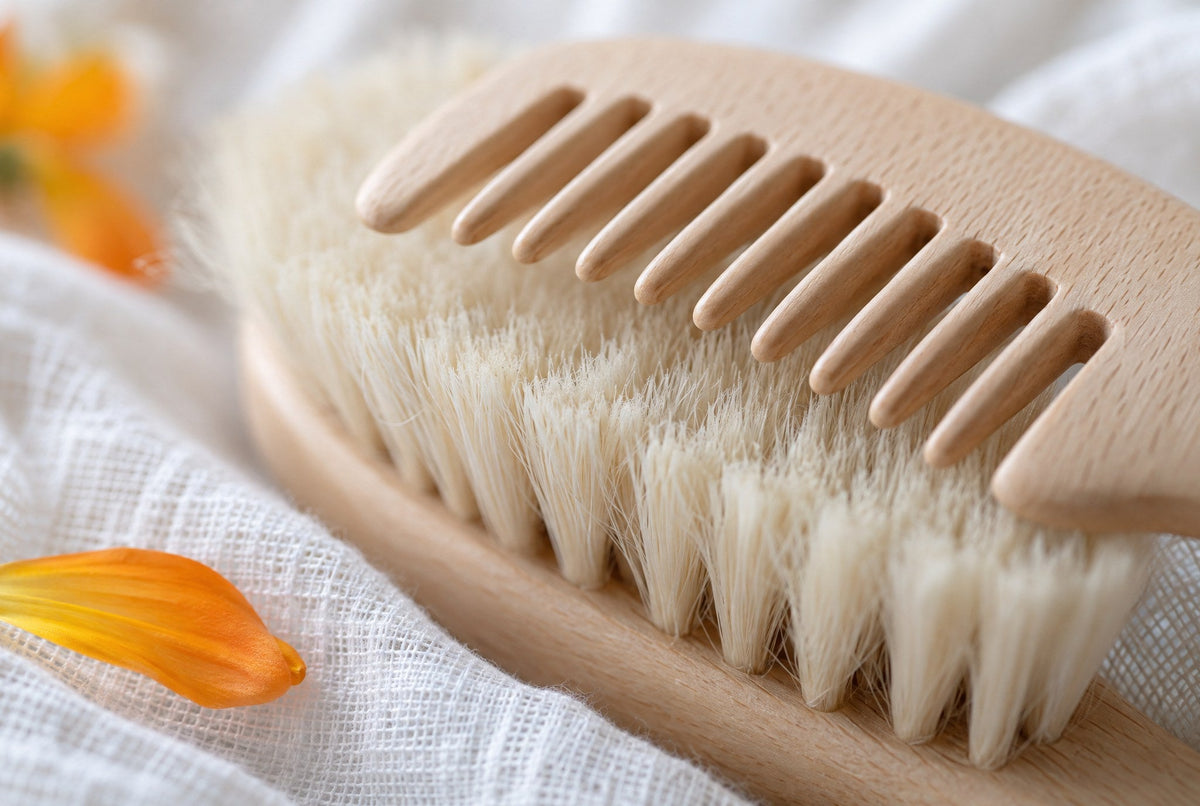
- Loosen rather than scrape. Once thicker scales have softened, a soft baby brush or comb can be passed gently across the area. Only lift what comes away easily. Fine dry flakes that already shed on their own do not need brushing or aggressive exfoliation.
- Do not pick. The AAP warns that scratching or picking at cradle-cap scales can increase the risk of infection. If a few hairs come away with the scales, the AAP notes that they grow back.
- Use less, not more. Oils work best here as a small part of the routine rather than a heavy coating. A few drops are easier to spread evenly and make it easier to see how the baby's skin responds.
For background, one read covers how a baby's skin cycle shapes a gentle routine, and another explains why children's hair deserves its own care approach.
When to Call the Pediatrician
The AAP lists the signs worth a call: cradle cap that becomes crusted, weepy or develops pus bumps, a rash in places other than the scalp that looks severe, a rash with an odour, oozing or bleeding from the scales, skin that looks swollen, or a baby who appears to be in pain or discomfort. A pediatrician may recommend an antifungal or hydrocortisone cream, and can check for other conditions.
The ordinary safety furniture applies either way: patch test anything new on a small area, introduce one new product at a time, apply to clean unbroken skin, and see a pediatrician for anything spreading, blistering, feverish or simply not improving.
Where to Begin, and How to Give It a Week
The flakes point one of two ways. Dry and loose calls for moisture support and softer cleansing; crusted and greasy calls for patient softening followed by gentle washing. Neither rewards scrubbing. Keep the routine consistent for a week rather than switching products every few days. A few photos in good light, taken several days apart, read small changes better than memory does.
For a simple way to add moisture support to the routine, explore Mavey Jaymes baby care collection.
Frequently Asked Questions
Is cradle cap contagious or a sign of poor hygiene?
Neither. The AAP states plainly that cradle cap is not caused by poor hygiene, and the NHS notes it cannot be caught from other babies. The flakes form from the scalp's own oils mixing with normal shedding, which is a stage many babies pass through. Gentle care and a little patience carry most families through it.
Can cradle cap show up in a baby's eyebrows?
Yes. The NHS lists the face alongside the scalp, and the AAP adds the neck crease, armpits and diaper area. The handling stays the same: keep the touch gentle and leave the flakes to loosen rather than picking. Keep oils and cleansers well clear of a baby's eyes.
Can baby oil help with the cradle cap?
Oil can be useful for softening thicker scales before gentle washing or brushing. The point is not to scrub the cradle cap away in one go. Use a small amount, allow stubborn scale to soften and remove only what releases easily. If the scalp becomes red, sore, weepy or irritated, stop home treatment and speak with a pediatrician.
Should a baby's hair be washed every day?
For cradle cap specifically, the AAP suggests washing more often, with every other day helping most babies. For a dry scalp the opposite usually applies, since frequent washing can contribute to dryness. Let the flakes guide the routine: crusted and greasy may benefit from more regular washing, while powdery and tight calls for gentler cleansing and moisture support.
What is the difference between cradle cap and eczema in a baby?
Cradle cap is greasy, crusted and rarely itchy, and most babies seem untroubled by it. Eczema-style dryness reads rougher and more irritated, with itch cues like fussing or rubbing, and none of the greasy scale.
Why did some flakes come off with the hair?
Cradle cap scale sits right against the hair and can catch a few strands as it loosens. Both the AAP and the NHS address this directly and say the hair will grow back. Easing flakes away slowly across several wash days is kinder than forcing them, so a lighter hand keeps shedding to a minimum.